
The Dock as the Supply Chain's Achilles' Heel
For many logistics and supply chain professionals, dock operations are the last place they expect to find transformational efficiency gains. Yet the reality is that the loading dock is often the single greatest bottleneck in an otherwise optimized warehouse or distribution center. No matter how advanced your WMS or upstream automation is, if trailers can't be loaded and unloaded quickly, throughput suffers.
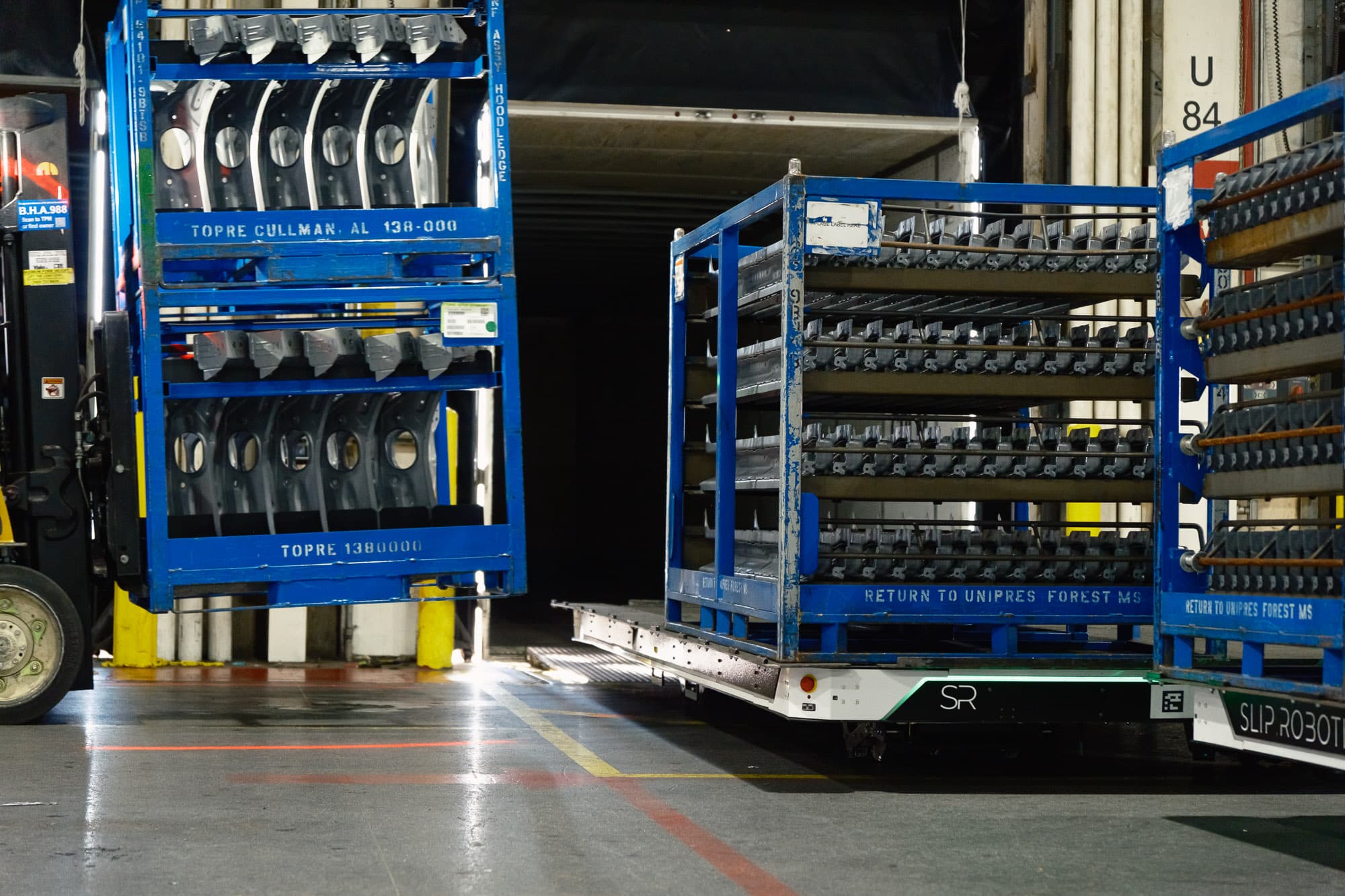
Automated Loading Robots (ALRs) from Slip Robotics are changing that. These mobile, autonomous systems transform slow, manual dock operations into fast, consistent, and safe workflows that dramatically increase efficiency.
The Common Pain Points at Dock Operations
- Driver wait times & detention fees: Trucks sit idle waiting to be loaded/unloaded.
- Manual loading inefficiencies: Human-led forklift operations introduce variability and errors.
- Safety risks: Forklifts entering trailers cause product damage, injuries, and operational hazards.
- Congested docks: Staging areas and dock doors are overwhelmed by freight and equipment.
- Inconsistent throughput: Varying labor skill and trailer configurations lead to unpredictable dock times.
How Automated Loading Robots Solve These Problems
Slip Robotics' SlipBot operates as a mobile staging lane that autonomously enters and exits trailers, transporting full pallet loads in and out. With no Wi-Fi or IT integration required, deployment is rapid and seamless. The system supports operator oversight while minimizing human entry into trailers, making the process safer and more consistent.
Real-World Results: Case Studies
- ABC Automotive: Reduced trailer loading time from 40+ minutes to under 3 minutes, achieving 4x throughput and 91% truck idle time reduction.
- Valeo: Implemented 26 SlipBots, achieving 6x dock speed and dramatically reducing forklift congestion.
- Four Hands: Cut unloading time by 75% and loading time by 50%, achieving a 4x throughput boost.
ROI & Soft Benefits
- Faster truck turn times, reducing detention fees
- Lower product damage and trailer repair costs
- Improved employee safety and morale
- Optimized space utilization in docks and staging
- Greater on-time shipping reliability
Implementation Best Practices
- Start with a single pain-point lane
- Align stakeholders across ops, safety, and IT
- Use data to track and validate gains
- Expand based on measurable success
Conclusion: Turn Bottlenecks Into Throughput Engines
The loading dock doesn't have to be a constraint. With Slip Robotics' automated loading solutions, warehouses and manufacturers can dramatically increase speed, safety, and savings. Request a demo or site audit to see how Slip Robotics can unlock dock-side ROI.
More Articles
Truck Loading Automation
Truck loading automation explained for dock teams. Learn how automated truck loading systems improve trailer turns and dock consistency, what physical dock automation covers versus software, and where SlipBot and SlipLift fit by freight type and route pattern.
OperationsAutomated Trailer Loading
Automated trailer loading explained: how robotic loading systems turn trailers in minutes, handle unloading too, and deploy without facility changes.
OperationsLoading and Unloading Trucks
A field guide to steadier dock flow: practical moves for staging, fewer trailer entries, and manual vs. automated loading, plus where SlipBot and SlipLift fit. Loading and unloading trucks gets easier when the dock follows a rhythm instead of a scramble.
Ready to transform your dock operations?
See SlipBots in action with a personalized demo.