
For years, supply chains have invested heavily in transportation optimization, warehouse automation, and inventory planning. Yet one of the most critical parts of the operation, the dock, has remained largely manual, variable, and difficult to control.
We've seen this firsthand.
The dock is where all the variability in a supply chain shows up first. When a trailer is late to load or unload, that delay doesn't stay contained. It ripples into production schedules, inventory levels, labor planning, and transportation reliability. A few minutes lost at the dock can quickly turn into hours of downstream impact.
The belief that improving the dock has disproportionate leverage across the entire operation led us to start Slip Robotics.
SlipLift represents the next step in our journey.
Docks Are the Bottleneck Often Ignored
Even in highly automated facilities, trailer loading and unloading is often still handled the same way it has been for decades: forklifts, manual labor, and tightly choreographed workarounds.
Every trailer turn depends on: • Labor availability • Freight mix • Congestion on the dock • Timing with drivers and transportation schedules
The result is variability that's hard to plan around and even harder to eliminate.
When docks slow down, inventory backs up waiting for trailers. Floor space fills with staged freight. Labor costs rise to handle peaks and exceptions. Delivery commitments become estimates instead of guarantees.
We believe docks shouldn't operate this way. And more importantly, they don't have to.
It Started With SlipBot
We didn't start by trying to automate every dock or every route.
We started where the problem was most obvious: short-haul, high-frequency routes between facilities.
In these closed-loop operations, inefficiency compounds fast. When a route runs six, eight, or ten times per day, even small delays add up quickly. What we saw consistently was that the dock was the constraint.
SlipBot was built to remove that uncertainty.
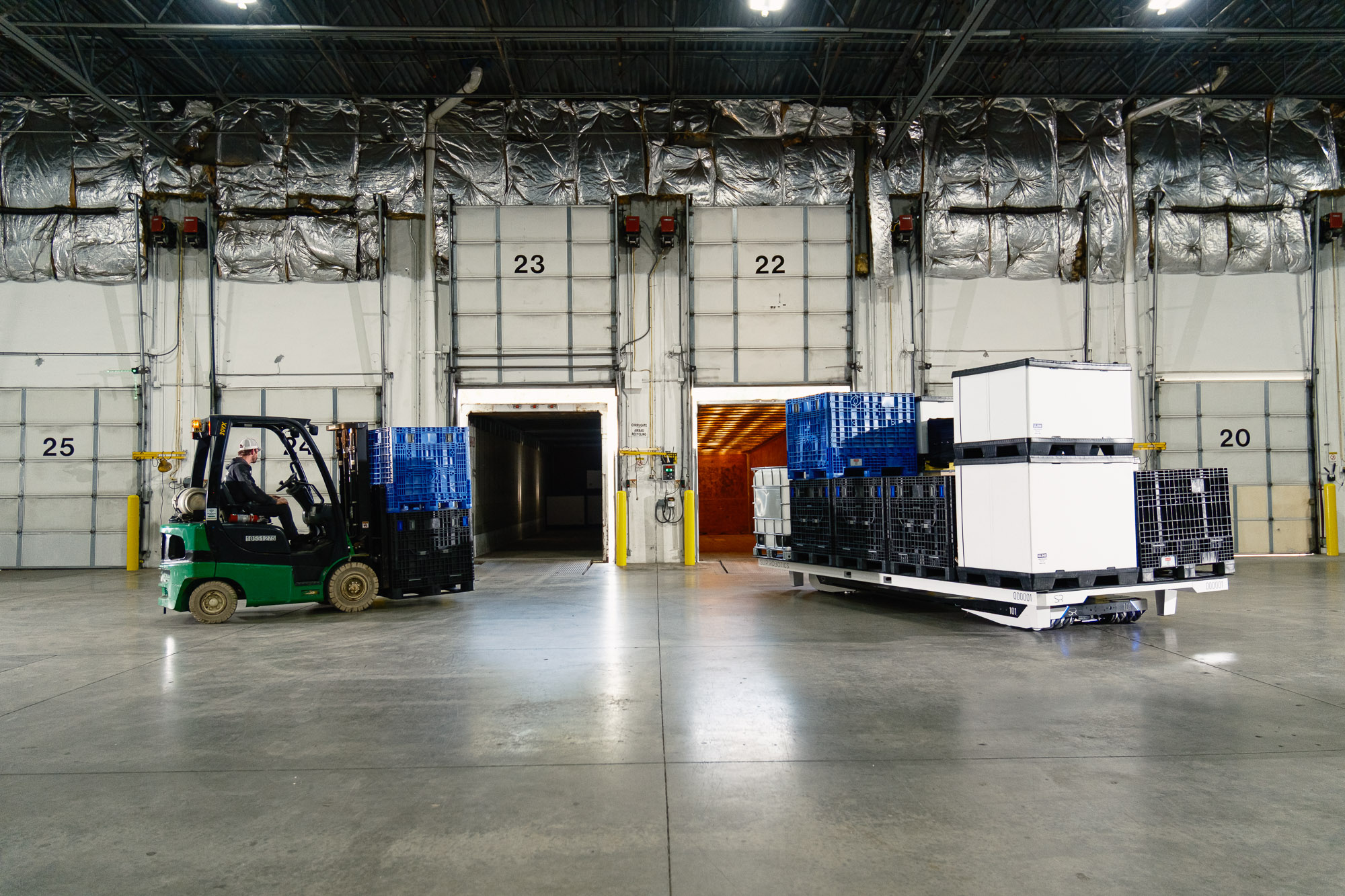
By autonomously loading and unloading trailers in five minutes, we gave operations something they rarely have: predictability. Once teams knew exactly how long a trailer turn would take, they could plan labor, transportation, and production with confidence.
SlipBot proved that autonomous trailer loading and unloading could be fast and reliable. But it also showed us where the model needed to evolve.
Why We Built SlipLift
As SlipBot deployments expanded, we started hearing the same questions from customers.
They wanted to automate heavier freight loading & unloading. They wanted more flexibility beyond short-haul, high-frequency routes. They wanted automation to work even when routes were lower volume.
In other words, they wanted "the same speed, safety, and simplicity across a broader set of real-world operations."
Traditional automation approaches struggle here. Supporting more routes usually means deploying more robots, adding infrastructure, or changing workflows. That quickly erodes ROI, especially when frequency drops.
SlipLift was built to break that tradeoff.
SlipLift Payload and Architecture
SlipLift isn't just a higher-capacity robot. It's a different way of thinking about dock automation.
With SlipBot, the robot traveled with the load. That made sense in closed-loop environments where utilization stayed high.
With SlipLift, we decoupled the robot from the payload.
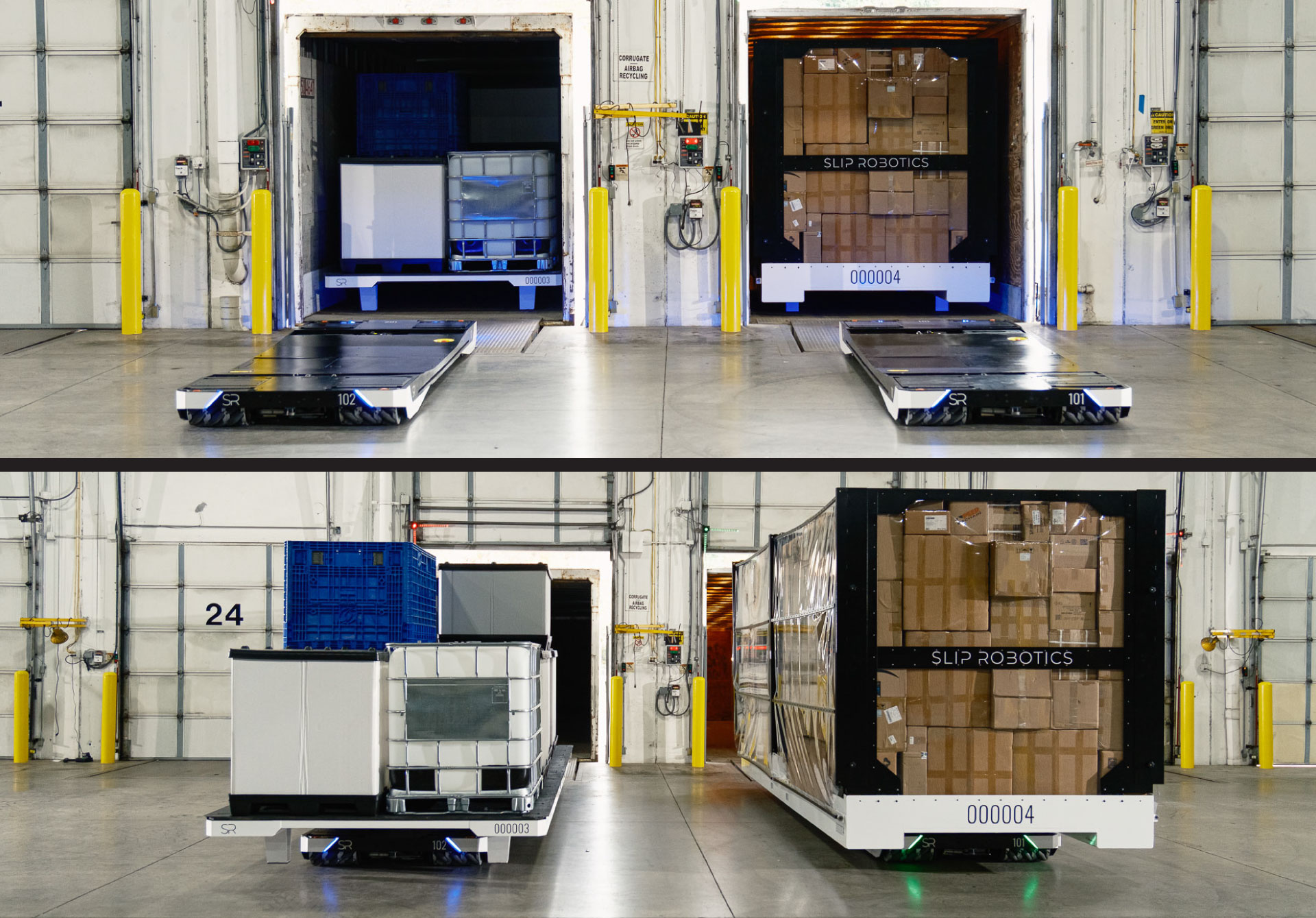
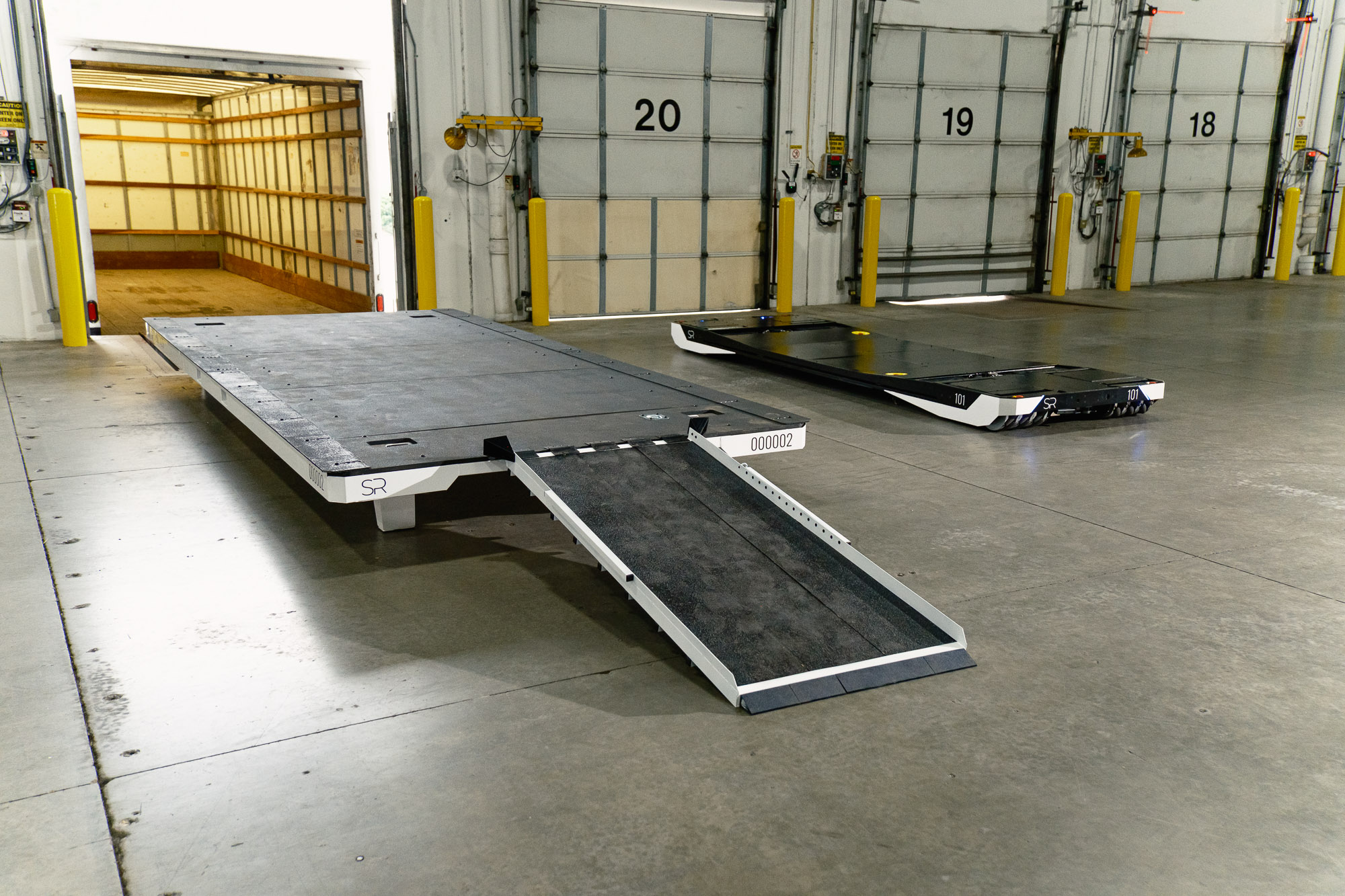
Payload capacity increases to up to 20,000 pounds, but more importantly, the robot no longer travels with the freight. Instead, a passive unit (SlipCarrier Tray), becomes the element that moves through the transportation network.
The robot stays at the dock, where it creates the most value.
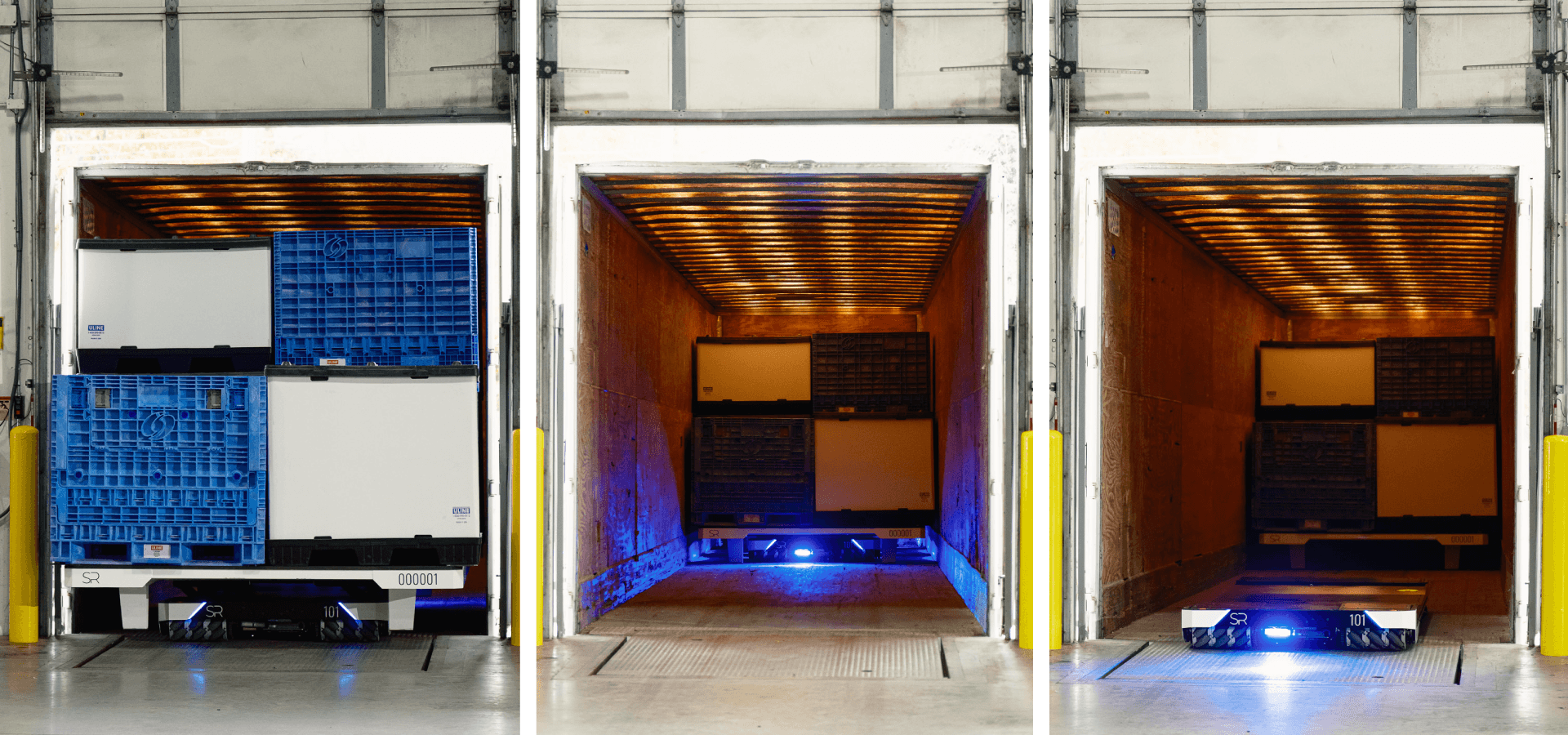
Trays can be loaded with freight ahead of time. SlipLifts lift them, move them into trailers, place them precisely, and return to the dock ready for the next move. At the destination, another SlipLift unloads the Tray just as quickly.
This architectural shift is what unlocks everything else.
Why That Matters: Economics and ROI
Decoupling the robot from the payload fundamentally changes how dock automation scales.
Because robots are no longer tied to individual routes: • Fewer robots can support more docks • Utilization stays high even when schedules vary • Automation becomes viable in lower-frequency environments
Instead of asking customers to justify more robots, we focused on getting more value out of the robots already on the floor.
This is what allows SlipLift to work beyond closed-loop shuttles.
Medium-haul routes, last mile deliveries, and facilities with fewer daily trailer moves can now justify automation because dock performance becomes predictable.
A True Two-Platform Portfolio
SlipBot remains the most efficient solution on the market for high-frequency, closed-loop shuttle routes. SlipLift expands Slip's reach into dock-centric, variable-route, and mixed-freight operations.
"SlipBot and SlipLift together allow Slip Robotics to load and unload ANY truck in 5 minutes."
How SlipLift Works: Human-in-the-Loop, Built for Safety
SlipLift is designed around a simple operating model: humans orchestrate and robots execute.
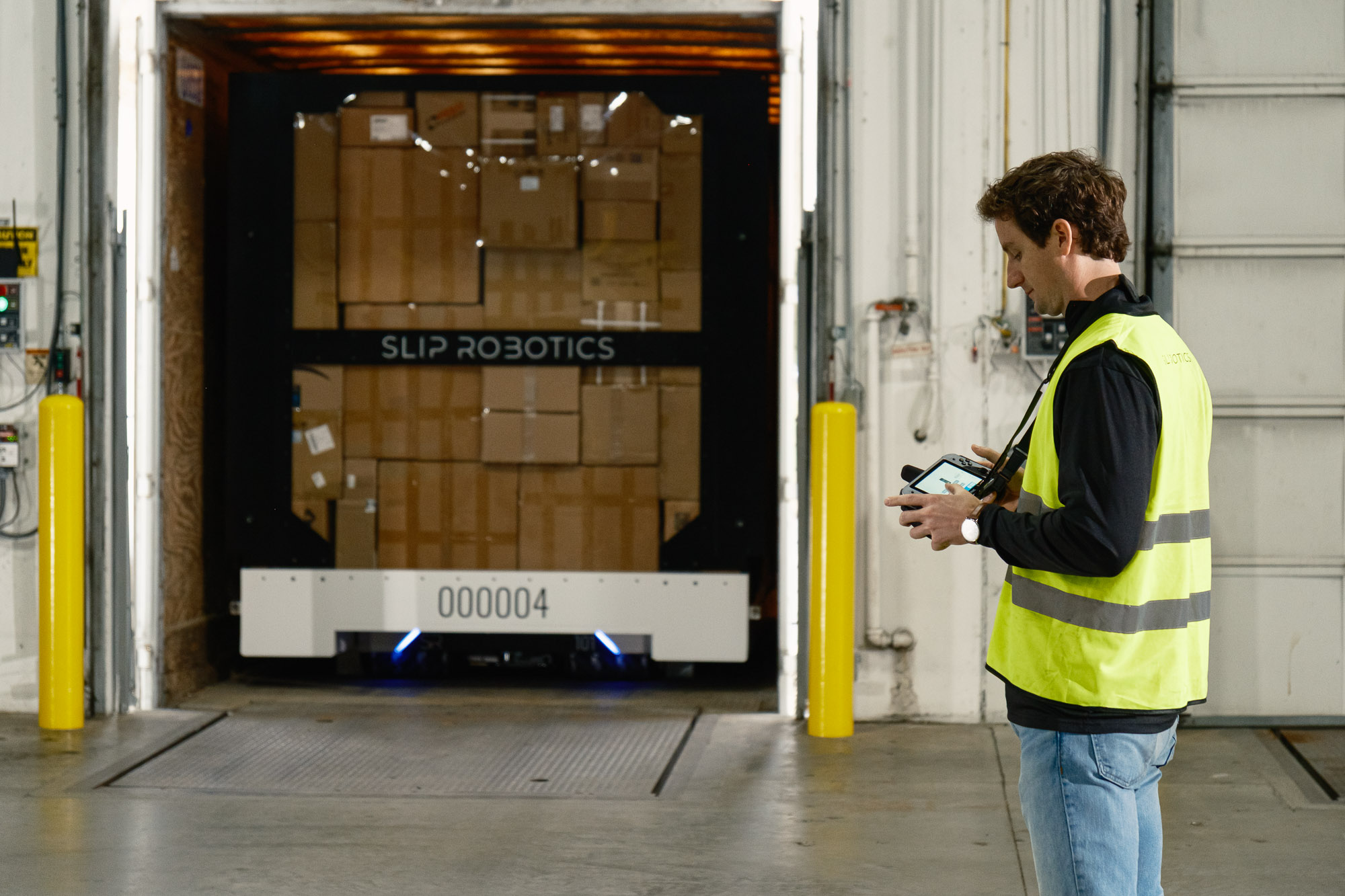
Operators decide what moves next and when, while SlipLift autonomously handles the physical work of moving Trays, entering and exiting trailers, and placing freight precisely where it needs to go. This division of responsibility keeps people focused on flow and decision-making, not on repeated, high-risk manual tasks.
The result is a dock environment where operators stay out of trailers and away from the most dangerous parts of the job, without giving up visibility or control. Autonomy doesn't replace human judgment; it removes unnecessary exposure and physical strain from daily operations.
Safety is built into every step of the process. Robot movement is clearly communicated, conditions are continuously monitored, and the system stops when something isn't right. Autonomy is intentional and predictable, operating only where it makes sense and stopping when conditions aren't right.
"We're not trying to remove people from the dock. We're removing risk, variability, and manual effort from their day."
Where SlipLift Is Used
SlipLift expands where we can deliver value across the logistics network.
Regional distribution networks
Facilities serving multiple downstream locations often deal with fluctuating schedules, mixed freight, and uneven route frequency. SlipLift brings predictability to these docks by standardizing trailer turns, even when routes change day to day.
Last-mile and box truck operations
Last-mile and box truck operations are some of the most challenging environments to automate at the dock. These facilities often deal with tighter dock layouts, smaller trailers or box trucks, limited staging space, and frequent schedule changes. Volumes can fluctuate throughout the day, and drivers are frequently expected to load or unload their own trucks—pulling them off the road and into the dock for extended periods of time.
SlipLift was designed to work in exactly these conditions. Because it does not require dock modifications or specialized trailers, it can be deployed in constrained last-mile environments without disrupting existing workflows. Trays can be staged and loaded ahead of time, allowing SlipLift to load and unload box trucks quickly and consistently, so drivers spend less time at the dock and more time on their routes. The result is faster turns, reduced driver dwell time, and a more predictable dock operation where flexibility and throughput matter most.
Industrial and manufacturing facilities with heavier freight
Many manufacturing environments move dense, heavy loads that exceed the practical limits of traditional dock automation. SlipLift supports payloads up to 20,000 pounds, allowing these facilities to automate routes that previously relied entirely on forklifts and manual labor.
Lower-frequency routes
SlipLift's decoupled architecture allows automation to make sense even when routes occur only a few times per day because robots stay productive at the dock, not on the road.
Across all of these environments, the outcome is the same: faster trailer turns, safer dock operations, and a level of consistency that manual processes can't match.
The Future of Dock Automation
SlipLift is not a replacement for SlipBot. It's the next foundational piece of Slip's mission to eliminate variability, increase throughput, and simplify material flow at the dock.
Across industries, customers are looking for: • Reduced dwell time • Smaller, more efficient buildings • Safer dock operations • Standardized material flow • Predictable, reliable trailer handling
SlipLift was engineered to deliver exactly those outcomes, at scale, without complexity.
Slip started by proving that dock automation doesn't need to be complicated to be transformative. With SlipLift, we are proving something even more valuable: dock automation can be universal.
More Articles
Truck Loading Automation
Truck loading automation explained for dock teams. Learn how automated truck loading systems improve trailer turns and dock consistency, what physical dock automation covers versus software, and where SlipBot and SlipLift fit by freight type and route pattern.
OperationsAutomated Trailer Loading
Automated trailer loading explained: how robotic loading systems turn trailers in minutes, handle unloading too, and deploy without facility changes.
OperationsLoading and Unloading Trucks
A field guide to steadier dock flow: practical moves for staging, fewer trailer entries, and manual vs. automated loading, plus where SlipBot and SlipLift fit. Loading and unloading trucks gets easier when the dock follows a rhythm instead of a scramble.
Ready to transform your dock operations?
See SlipBots in action with a personalized demo.